Electrician Website Examples: What the Best Electrician Websites Show
What the best electrician websites put in front of a nervous homeowner, a landlord and a facilities manager, shown on two demo designs, with the registration, EICR, EV charger and call-out details that win the job.
Electrics are the job people are most nervous about hiring for. They can't see the work once the plaster's back on, and they know a bad job can burn the house down. So the electrician website examples worth learning from aren't the flashiest. They're the ones that settle those nerves in a few seconds, then make it dead easy to ring.
Below is what the best electrician websites show, and why, using two demo homepages I've designed as illustrations. Then the pages an electrician's site needs, how to handle emergency call-outs and commercial work, and the mistakes I see most.
Best electrician websites: what they show in the first five seconds
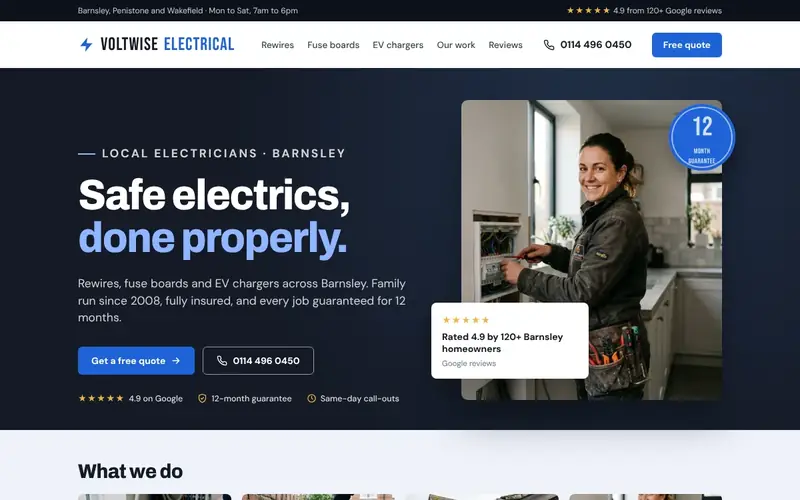
Here's my Voltwise Electrical demo, for a made-up firm in Barnsley, from the top down:
- A thin strip across the top: "Barnsley, Penistone and Wakefield · Mon to Sat, 7am to 6pm", with the Google rating on the right.
- A menu that reads like a job list: Rewires, Fuse boards, EV chargers, Our work, Reviews. Then the phone number and a "Free quote" button.
- A small line above the headline: "Local electricians · Barnsley".
- The headline "Safe electrics, done properly." Safety is the worry, so it's the first word.
- One line underneath with the jobs, the town, how long the firm has been going, that it's fully insured and what the guarantee is.
- Two buttons, "Get a free quote" and the phone number, then three small trust points: the Google rating, a 12-month guarantee and same-day call-outs.
- A photo of an electrician actually working at a consumer unit, not a stock model with a screwdriver.
On a phone, the same page puts the photo first, the headline and buttons straight after, and a bar fixed to the bottom of the screen with "Call us" and "Free quote". Whoever's looking, and however far they scroll, ringing you is one tap away.
None of that is clever design. It's the questions a nervous customer asks, answered in the order they ask them: do you do my job, do you cover my area, are you safe, are you any good, how do I get hold of you.
Two electrician website examples, two different jobs
My second demo, Brightline Electrical, is for a made-up firm in Leeds that does both domestic and commercial work. It's built differently, and it's worth comparing honestly.
The header says "Call day or night" above the number, with a "Book Now" button next to it. The headline is "Residential & Commercial Electrical Repair & Service", and the line underneath says the firm is NICEIC approved, covers Leeds and West Yorkshire, offers same-day call-outs and fixed quotes, and certifies every job. The photo is the electrician walking away from a white van with ladders on the roof, on a street of red-brick terraces that looks like it could be anywhere in Yorkshire.
What it does well: the registration body is in the first sentence, the area is named, and "every job certified" answers a question a lot of homeowners don't know how to ask. What I'd watch on a live version: a headline that covers residential and commercial at once is a compromise. A homeowner with a tripping circuit and a facilities manager looking for a testing contractor want different things, and the strongest electrician websites give each of them their own route in. More on that below. I'd also swap "NICEIC approved" for the exact name of the registration held, because a domestic installer registration and an approved contractor assessment aren't the same thing, and the people who know the difference are the ones you most want to convince.
And "Call day or night" only belongs on the page if someone really answers at night. If you don't, say your real hours. Customers forgive limited hours. They don't forgive a promise that rings out.
NICEIC, NAPIT and Part P: showing your registration properly
This is the bit most electrician websites get wrong, usually by accident.
Part P is the part of the Building Regulations in England and Wales that covers electrical safety in homes. Some domestic work, like replacing a fuse box or changing electrics near a bath or shower, may need building regulations approval. If the homeowner uses an electrician registered with a competent person scheme, they don't have to get that approval themselves. NICEIC and NAPIT are two of the organisations that run those schemes.
So the useful thing to show isn't a row of logos. It's a plain sentence: which scheme you're registered with, in which category, and your registration number. Homeowners can check it on the Registered Competent Person Electrical register, which lists electricians registered to work in homes in England and Wales and lets people search by company name. A number that checks out does more for you than any badge.
Three things the best sites don't do:
- Say they're "Part P qualified". There's no such qualification. What exists is scheme registration.
- Show a logo for a scheme they've let lapse. It's the quickest way to lose a job at the checking stage.
- Suggest a domestic registration covers commercial work when it doesn't.
I go into the exact wording in electrician SEO for EV chargers and rewires, along with how to write each service page so it ranks.
The pages an electrician's website needs
Electrical work is several different jobs bought by several different people. The best electrician websites give each one its own page, written for that customer.
Rewires
Your biggest domestic job, and the most nerve-racking for the customer: they're picturing floorboards up and no power for a week. A good rewire page explains what happens, roughly how long you're in the house, whether they can stay living there, how you deal with the dust and the replastering, and shows photos of tidy finished work.
Consumer unit upgrades
Call it a fuse board upgrade as well as a consumer unit, because that's what most homeowners call it. These customers have often been told by someone else that theirs is old or unsafe, so they want a plain explanation and a rough idea of cost, not a lecture.
EICRs for landlords
Landlords in England have to get the electrics in their rented homes inspected and tested at least every five years. That makes EICRs repeat business, and landlords and letting agents buy differently from homeowners: they want quick booking, clear prices, how you report, and how you handle any remedial work. A separate page for landlords and agents, written in their terms, tells them you're set up for it.
EV charger installation
The customer has usually just bought an electric car and is researching for days. A good EV page answers the questions they're typing into Google: which chargers you fit, what a survey checks, how long the job takes, and whether there's a grant.
On that last point, get the facts right. As of October 2026, the government's chargepoint grants for home charging are aimed at renters and flat owners with off-street parking (75% of the cost, up to £500) and at households with only on-street parking, with funding confirmed until 31 March 2027. The grant has to go through an OZEV-authorised installer, so if you're authorised, say so on the page. Homeowners in a house with a driveway generally won't qualify, and a site that says so plainly earns more trust than one that hints at free money.
Fault finding and emergency call-outs
Short, plain and built around one big call button. More on this in the next section.
Commercial work
If you do it, it needs its own section: the kinds of premises you work in, testing and inspection, out-of-hours work, and the accreditations and insurance a commercial buyer will ask about. See the table further down.
Add a page for each town you genuinely cover once the service pages are done, so you show up for "electrician near me" where you actually work.
Emergency call-outs: how the best sites handle them
Someone with no power, a tripping circuit or a burning smell isn't reading. They want to know three things: can you come, when, and roughly what will it cost. The best electrician websites answer all three on a short emergency page.
- Real hours, stated plainly. "Same-day call-outs, Monday to Saturday, 7am to 6pm" is better than a vague "24/7" you can't keep.
- How you charge for call-outs. A call-out fee, a first-hour rate, or a line saying you'll give a price on the phone before you set off. Any of those beats silence.
- What happens when they ring: who answers, how quickly you'll call back if you're on a job, roughly when you can get there.
- The call button stays on screen the whole time. No form-only route for an emergency.
- The areas you'll travel to for an emergency, which may be smaller than the areas you cover for planned work.
If you can't answer the phone on a job, that's not a website problem but it is a lost-work problem. A missed-call text back means the caller at least gets a reply while you're up a ladder.
Domestic vs commercial: one site, two front doors
Lots of electrical contractors do both, and most electrical contractor website examples I see try to serve both buyers from one homepage. The trouble is that the two buyers are convinced by opposite things, so one homepage trying to please both often pleases neither.
| What differs | Homeowner | Commercial buyer |
|---|---|---|
| What reassures them | A face, a van, tidy work, local reviews, a clear price | Insurance limits, the right accreditations, similar sites you've worked on, out-of-hours cover |
| What they search for | The problem and the town ("electrician Barnsley", "fuse box replacement") | The service and the sector ("commercial electrical testing", "emergency lighting testing") |
| What they want to do next | Ring now, or get a quote | Send an enquiry, ask for documents, arrange a site visit |
| What puts them off | Jargon and no prices | Kitchen downlight photos and "friendly local sparky" wording |
The fix is simple: keep the homepage for the customer who brings in most of your work, and give the other one a clear link to their own section. A commercial section might cover the premises you work in, testing and inspection, a list of accreditations (an NICEIC Approved Contractor assessment rather than a domestic registration, plus whatever pre-qualification schemes your clients ask for, such as CHAS, SafeContractor or Constructionline), and a named contact for tenders.
The mistakes I see on electrician websites
- One "Services" page listing rewires, EICRs, EV chargers, CCTV and PAT testing in one go.
- A stock photo of sparks flying from a socket. It's meant to look exciting. To a homeowner it looks like a fire.
- Logos with no registration number, or a logo for a scheme the business has left.
- "Part P qualified".
- No EV charger page at all, even though the firm fits them every week.
- A phone number you can't tap on a phone.
- A "24/7" promise that goes to voicemail.
- The same site trying to talk to homeowners and facilities managers in the same paragraph.
Score your electrician website in two minutes
Open your site on your phone and answer yes or no:
- Does the first screen say you're an electrician and name your town?
- Can you ring yourself with one tap, from any page?
- Is your scheme registration on the page, with the number?
- Do rewires, consumer units, EICRs and EV chargers each have their own page?
- Are the photos of your own work?
- Are your emergency hours and call-out charges stated honestly?
- Are the towns you cover listed?
- If you do commercial work, does it have its own section?
Six or more yeses and your site's probably doing its job, so your problem is more likely getting found than getting chosen. That's what SEO for electricians is for. Fewer than five and the site is losing you work you've already been found for. If that's you, start with why trade websites don't get enquiries.
If you want to see the same patterns across other trades, I've broken down trades website examples for plumbers, builders, landscapers and more.
Want a site like this for your electrical business?
Both demos above were designed by me, and I'll design one for you: your homepage, for your firm, within 24 hours of our set-up call, before you pay anything. If you like it, the full site is £497 one-off, no VAT, live within 7 working days of your start date, and you own it outright. If you don't, you walk away and owe nothing.
See what's included on my websites for electricians page, or skip straight to your free website mockup. If your current site already scores well, I'll tell you to keep it.