

Most Construction Websites Don't Look Good.
They Don't Win Much Work Either.
Construction website design isn't about a drone video of a crane at sunset. The quantity surveyor checking you before a tender, the main contractor vetting subcontractors and the client planning a big build all want the same thing: proof you've done this kind of job before, and done it properly.
Most construction company websites hide that proof. Lovely photos with no project names, accreditation logos that lapsed two years ago, and a contact form that feeds an inbox nobody checks. Good website design for construction companies puts that proof first, so the site does some of the shortlisting for you.
I build websites to do exactly that.
-
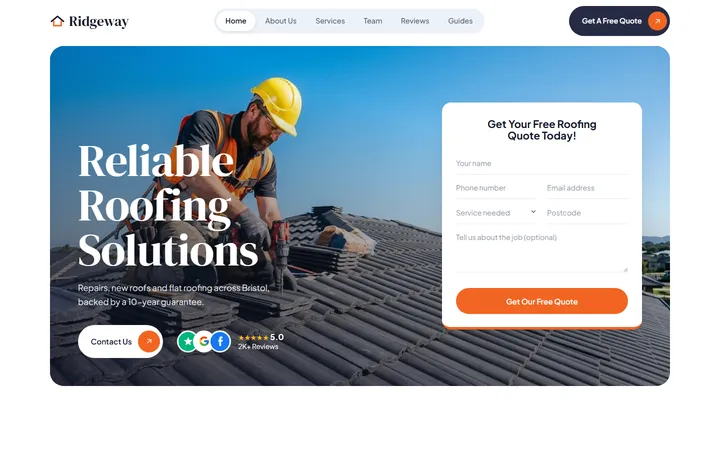
Ridgeway Roofing
Roofing
-
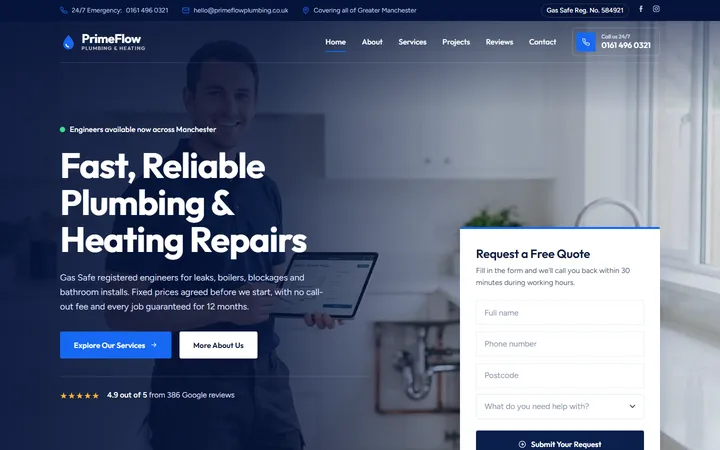
PrimeFlow Plumbing
Plumbing
-
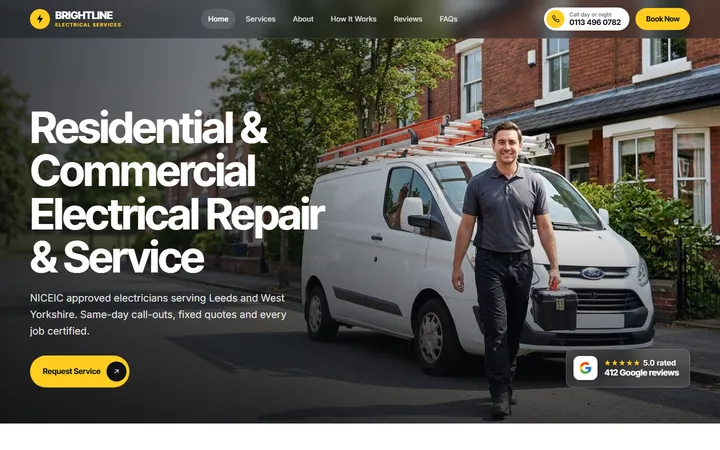
Brightline Electrical
Electrical
- 01FoundSEO architecture built in from the start.
- 02ChosenProof and design that make you the obvious call.
- 03ContactedEvery important page leads towards an enquiry.
Stop renting your growth.
Ads disappear when you stop paying. Your website doesn't.
What buyers check before they shortlist a construction company
Commercial buyers and private clients check different things, but they all check. These are the questions your website should answer before anyone picks up the phone.
- 01
Have you built something like this?
Buyers want work like theirs: the same sector, a similar size, nearby. Case studies with the scope, location and programme answer that far better than a gallery of unnamed photos.
- 02
Are your accreditations current?
CHAS, Constructionline, an SSIP scheme or ISO certificates help buyers shortlist. Show the level you hold and when it renews, because a lapsed logo does more harm than no logo.
- 03
Can you handle a job this size?
Your team, the trades you cover in-house, the regions you work in and the size of contract you're comfortable with. Being clear about your range brings in the right enquiries.
- 04
Who do I actually speak to?
A named contact for estimating, a direct number and a real address. Buyers who can't find a person move on to a firm where they can.
Built to get you found.
Built to get you chosen.
Built to get you contacted.
Here's what built properly looks like for construction companies. Each page has one job: making it easy for the right customer to find you, trust you and get in touch.
- 1
Built to get you foundPages for each service, sector and region you work in, each backed by real projects, plus the technical groundwork Google needs to understand them.
- 2
Built to get you chosenCase studies with scope and programme, current accreditations with renewal dates and named contacts, right where buyers and private clients build their shortlist.
- 3
Built to get you contactedA direct number on every page, and an enquiry form that asks commercial and private clients the questions that matter, so serious enquiries stand out.
The pages a construction company website needs
Buyers search by service, sector and region. Each of those gets its own page with real projects behind it, instead of one long list of everything you've ever built.
Service pages
One page per package you deliver, such as groundworks, new build, refurbishment, fit-out or extensions, each with the projects that prove you can do it.
Sector pages
Education, healthcare, commercial, residential or industrial, each gathering the projects and accreditations that sector's buyers care about.
Project case studies
The client where you're allowed to name them, the location, scope, programme and the problems you solved, with photos of your own work.
Accreditations and policies
Each scheme, the level you hold and when it renews, with certificates to download, plus your health and safety, quality and environmental policies.
Careers
Each role with its location, the type of projects involved and the CSCS card it needs. Skilled people check a firm before they apply.
Region pages
The areas you cover, backed by real local projects and the office or yard that serves them, not the same page with the town name swapped.
Everything you need
to win work online.
No templates. No missing essentials. Everything below is included in your website.
- 01Mobile-first design
Built for phones first, where most of your customers will see you.
- 02Project case studies that sell
Each project written up with scope, location, programme and photos, sorted by sector so buyers find work like theirs in seconds.
- 03Accreditations, current and checkable
CHAS, Constructionline, SSIP, ISO and the rest, with the level you hold and when it renews. Only what you actually hold.
- 04The right questions for every enquiry
An enquiry form that asks commercial clients and private clients what matters for their kind of job, with a direct number alongside.
- 05You own everything.
No rented website. No proprietary platform holding your business hostage. When it's finished, it's yours.

You've mastered your trade.
I've mastered mine.
Let's work together.
I've spent more than 10 years learning what makes websites rank, earn trust and generate enquiries. That experience goes into every website I build.
- 10+Years in SEO
- 100s#1 rankings
- 50K+Monthly organic visits
One person. Name on the work.
You work directly with me. I plan it, build it and I'm accountable for it. No account managers, no agency hand-offs, no outsourcing.
From first chat to
live website.
A straightforward process. I handle the website so you can get on with running your business.
- 01Tell me
Tell me about your business, customers and the work you want more of.
- 02I build
I plan, write, design and build the website. You don't have to figure it out yourself.
- 03You approve
You review everything. Once you're happy, I launch it.
Your job: Tell me about your business. Approve the finished work.
My job: Everything in between.
You don't need to: Write the copy Plan the pages Design anything Touch the tech
See it before you pay.
Own it once you do.
No big upfront gamble. No lock-in. No website held hostage.
- 01See it first
I build your website design before you pay anything. If it's not right, you're not out of pocket.
- 02You own it
Once you've paid, it's yours. You're free to take it elsewhere whenever you want.
- 03No lock-in
Stay because you want to, not because a contract forces you to.
One price.
Everything included.
Everything I think a trade business needs to get found, get chosen and turn more of that attention into enquiries.
Everything in The Job Winning Website
Worth on its own
- The Built-To-Win Website£1,995
- Google Set-Up£395
- The Trust Builder£195
- One-Tap Enquiries£195
- Bonus #1: The Competitor Map£295
- Bonus #2: Your Homepage In 24 HoursIncluded
- Bonus #3: The Missed-Enquiry Tracker£395
- Bonus #4: 90 Days Of Tweaks And Support£450
- The See-It-First GuaranteeOwe £0if you don't like it
- The 7-Day Launch Guarantee*£100if I'm late
- Worth on their own, added up
£3,920
What each part does
- The Built-To-Win Website
- Built around the jobs you want more of, and I write it for you. Every page is made to turn a visitor into a phone call.
- Google Set-Up
- I set up the things Google checks, so it knows what you do and which towns you cover.
- The Trust Builder
- Your reviews, job photos and trade badges, like Gas Safe or NICEIC, right where people decide who to ring.
- One-Tap Enquiries
- Tap to call and a short quote form on every page. Every enquiry comes straight to you.
- The Competitor Map
- Before I build, I check who's winning the searches in your area and where the gaps are. Then I build your site to go after them.
- Your Homepage In 24 Hours
- Your homepage design within 24 hours of your set-up call, before I build the rest and before you pay.
- The Missed-Enquiry Tracker
- See how many people tap to call you or send your form, and how many started the form then gave up.
- 90 Days Of Tweaks And Support
- For 90 days after launch, I keep improving the site based on what the tracking shows. Questions come to me, not a helpdesk.
- The See-It-First Guarantee
- You see your homepage design before you pay a penny. Don't like it? Walk away and owe nothing.
- The 7-Day Launch Guarantee
- Live within 7 working days of your start date, or I pay you £100 if the delay is down to me.*
Total
All 10 parts. See your homepage before you pay a penny.
£497
*Full terms below.
What is one good job worth to you?
Think about one of the jobs you actually want more of, like a refurbishment contract or a new-build extension. After materials and wages, roughly how much profit does one leave you?
Your website
£497
Type your figure to see the sum. Nothing is sent anywhere.
*
*Illustration only. A website can't guarantee enquiries or jobs.
After launch
- Hosting + web addressKeeps your site online. Paid by you, monthly. Exact amount in writing before you pay
- Local SEOOptional, month to month, if you want more from Google. £495 a month
No contract. SEO is only added if you want it.
Full terms: paying and guarantees
Paying
I take no deposit and no booking fee. You pay nothing until you've seen and approved your homepage design. Then you pay the full price in one go, and I build the rest. The price is one-off. No VAT to add.
The See-It-First Guarantee
Your homepage design comes within 24 hours of your set-up call. 1 round of changes is included before you decide. You then have 2 working days to say yes or no, so I can hold your build slot. The 7-day clock pauses while you decide. If you say no, you owe nothing, and the unused design stays with me.
The 7-Day Launch Guarantee
The 7 working days start on your booked start date, with your set-up call. The clock only runs once I have everything on my set-up list: your details, logins and photos. It pauses while I'm waiting on you: for feedback, answers, your decision on your homepage design, your payment or access to your web address. 'Live' means your site is up on your own web address. If it isn't live in time because of a delay on my side, I pay you £100 by bank transfer within 7 days of launch. It's money, not a credit.
What I don't promise
I don't promise rankings, calls, enquiries or jobs. Google decides when and where your pages show up. My guarantees cover my own work.
Website design for construction companies starts with who's reading
A plumber's website mostly talks to homeowners. A construction company's website has to talk to several very different readers, sometimes in the same week:
- Private clients planning a new build, a big refurbishment or premises of their own. They want similar projects, a clear idea of how you work and someone to speak to.
- Main contractors' supply chain teams looking for subcontractors. They want your packages, capacity, regions, accreditations and safety record.
- Public sector and commercial buyers shortlisting suppliers. They check accreditations, policies and project evidence before they read anything else.
- Skilled people deciding whether to apply for a job with you. They check your reputation, your projects and which cards and tickets the role needs.
Each of them arrives with a different question, and most construction websites answer none of them clearly. Good construction website design gives every reader a fast route to what they need: projects sorted by sector, an accreditations page that's up to date, a careers page, and a contact page with real names on it.
Say you run a groundworks and civils firm near Doncaster with thirty staff. A main contractor's buyer has your name from a recommendation and wants to know whether you've done housing infrastructure at their scale. If your website shows three relevant projects with the scope and programme, you're on the list. If it shows a slideshow of diggers and "quality you can trust", you're relying on a busy buyer making a phone call they may not bother with.
Project case studies: the page that does the selling
Case studies are the most persuasive thing on a construction website, because they show work that already exists. A good one is short, specific and easy to scan. It covers:
- The client, named if they're happy for you to say so, or described ("a regional housing association") if not.
- The sector and location, so buyers can find work like theirs, close to theirs.
- The scope: your package, what you built, and the value band if you're comfortable sharing it.
- The programme: how long it took, and whether you handed over on time.
- The problem you solved: the tight site, the live school, the ground conditions, the design change halfway through.
- Photos of your own work, during and after, captioned with what they show.
Then sort them by sector and service, and link each one from the matching service page. A buyer reading your refurbishment page should see your refurbishment projects right there, without hunting.
You don't need to write them yourself. Send me the photos and talk me through each job in a voice note on the drive home from site, and I'll turn it into a case study for you to check. If you'd like to see how other firms present their work, I've pulled together trades and construction website examples with what each one gets right and wrong.
CHAS, Constructionline, SSIP and CSCS: what buyers check
Commercial buyers use accreditations to shortlist before they look at anything else, so this is one page that has to be right. Here's how the main schemes fit together, as of October 2026:
- The Common Assessment Standard is Build UK's industry-agreed prequalification question set, with desktop and site-based levels. It's delivered by recognised assessment bodies including Constructionline (Gold and Platinum), CHAS (Elite), Achilles and SMAS Worksafe, and Build UK says central government and the wider public sector should use it to pre-qualify suppliers. The current list is on the Build UK website.
- SSIP (Safety Schemes in Procurement) exists so contractors don't have to repeat the same health and safety prequalification for every client. CHAS is a founder member. The details are on ssip.org.uk.
- Constructionline validates its members and checks them against PAS 91, the standard prequalification questionnaire, so buyers can search for suppliers who are already pre-qualified.
- CSCS cards belong to individuals, not companies. They prove a worker has the training and qualifications for their job on site. They aren't a legal requirement, but CSCS says most principal contractors and major housebuilders ask for them.
- ISO 9001, 14001 and 45001 (quality, environmental, and health and safety management) matter to some buyers, particularly on larger contracts.
On your website, each accreditation should name the scheme, the level you hold and when it renews, ideally with the certificate to download. Keep it current. A Constructionline logo from a membership that lapsed last year is worse than no logo at all. If you also work for homeowners, TrustMark or Federation of Master Builders membership belongs on the domestic pages, where those customers look for it.
Services, sectors and regions: how the site is structured
Buyers rarely search for "construction company" on its own. They search for the work: "groundworks contractor Yorkshire", "school refurbishment contractor", "commercial fit-out Sheffield". So the site is built around three kinds of page:
- Service pages for each package you deliver, such as groundworks, new build, refurbishment, fit-out or extensions, each with the projects that prove it.
- Sector pages for the markets you work in, such as education, healthcare, commercial, residential or industrial, each gathering the relevant projects and the accreditations that sector's buyers care about.
- Region pages for the areas you cover, backed by real local evidence: projects nearby, the office or yard that serves the area, and the people a buyer would deal with. Pages that swap the town name and nothing else won't help anyone.
Add a careers page, an about page with your actual team, and a contact page with named people for estimating and general enquiries. That structure gives Google something clear to rank. Once it's in place, SEO for construction companies is how you push those pages up the results over the following months.
Tenders and commercial buyers versus domestic clients
Be realistic about what a website does for tenders. Contracts are won on the submission, the price, your prequalification and your relationships. Nobody awards a place on a framework because they liked a homepage.
What a website does is back up everything in the bid. When an assessor or a main contractor's buyer looks you up, they should find the same projects, the same accreditations and the same people your submission describes. A site that's clearly current makes your bid more believable. A site last touched in 2019 quietly undermines it.
Private clients are different again. They want to see a project like theirs, understand how the job will run and feel safe trusting you with a large sum of money. If most of your work is for homeowners (extensions, loft conversions, renovations), my page on websites for builders is closer to what you need.
The enquiry form should reflect that split. A commercial enquiry is asked about the project, location, start date and whether drawings are ready. A private client is asked about budget, timescale and whether they have plans or planning permission. And every page carries a direct phone number, because some people would always rather ring.
What construction website design costs, and who mine suits
As of October 2026, this is roughly what UK firms are quoted for a website:
| Route | Typical price | Worth knowing |
|---|---|---|
| DIY website builder | Roughly £10 to £30 a month | You build and update it yourself, and it usually shows |
| Monthly website deal | Around £49 to £95 a month | Usually rented, so it goes when you stop paying |
| Freelance web designer | Usually £500 to £1,500 | Fine for smaller firms, if they understand case studies and accreditations |
| Agency | From around £5,000 for a standard site | More meetings, more people, more process |
| Larger custom build | £10,000 and up | Portals, big project libraries, integrations with other systems |
The Job Winning Website is £497, one-off, with no VAT and no deposit. Hosting and your web address are about £20 a month, paid by you. I'll be straight about who it suits: small and mid-sized construction firms that need their services, sectors, best projects, accreditations and enquiry routes set out properly, on a site that's quick on a phone. I build and write it myself.
It isn't the right fit if you need a client portal, documents behind logins, investor pages, several divisions under one brand or hundreds of old projects moved across. That's agency territory, and I'll tell you so on the first call rather than take the job. There's a wider price comparison in how much a website costs in the UK.
Construction website mistakes, and how I build yours
The same mistakes turn up on construction websites again and again:
- Accreditation logos for certificates that lapsed a while ago.
- Impressive photos with no project name, location or scope.
- A heavy drone video on the homepage that takes an age to load on a phone signal on site.
- A PDF brochure instead of proper pages Google can read.
- Only an info@ address and a form, with no named person anywhere.
- A news page whose latest post is three years old.
Here's how I build yours instead. On a set-up call you talk me through your services, sectors, best projects and accreditations, then send me photos and certificates. Your homepage design arrives within 24 hours of that call, before you pay anything. If you like it, you pay and I build the rest, live within 7 working days of your start date once I have what I need, or I pay you £100 if the delay is mine. Then I spend 90 days improving it based on what the tracking shows. The full process is in what to expect from the web design process.
Everything that's included is on the main Job Winning Website page. If your firm leans towards domestic building work, my page on marketing for builders covers the rest of the picture.
Construction website questions, answered.
How does payment work?
No deposit and no booking fee. You pay nothing until you've seen and approved your homepage design. Then you pay the full price in one go, and I build the rest. The price is one-off, with no VAT to add.
What if I don't like the first design?
You see your homepage design within 24 hours of your set-up call, before you pay anything, and 1 round of changes is included. If it still isn't right, walk away and owe nothing. That's the See-It-First Guarantee.
How long does the build take?
Your site goes live within 7 working days of your start date, once I have your details, logins and photos. If it's late because of a delay on my side, I pay you £100.
Do I own the website?
Yes. Your site, your domain and your content belong to your business. Nothing is held hostage.
What do I need to provide?
The basics: the services you offer, the areas you cover, and any photos of your work. I'll guide you through the rest.
Do I need to write anything?
No. I write every page based on your trade, your services and the areas you cover. You review it all before anything goes live.
What photos do you need?
Real photos of finished jobs, even ones taken on your phone. If you don't have enough yet, I'll tell you honestly where that leaves a gap, rather than filling it with stock photos that undersell your work.
How much does construction website design cost in the UK?
As of October 2026, freelancers usually charge £500 to £1,500 for a small business site, specialists £1,500 to £4,000, and agencies from around £5,000 for a standard one, and larger custom builds with big project libraries or client portals cost more again. Monthly deals of around £49 to £95 a month exist too, but you rarely own the site. Mine is a fixed £497, one-off, with hosting and your web address at about £20 a month on top, paid by you.
Is a £497 website enough for a construction company?
For a small or mid-sized firm, usually yes. My website design for construction companies is built for firms that need their services, sectors, best projects, accreditations and enquiry routes set out properly. If you need a client portal, documents behind logins, investor pages or hundreds of old projects moved across, that's agency work, and I'll tell you so on the first call rather than take your money.
What should a construction company website include?
A page for each service you deliver, pages for the sectors and regions you work in, project case studies with scope, location and programme, an accreditations page with levels and renewal dates, a careers page, and named contacts with a direct phone number. Real photos of your own projects matter more than anything a designer can add.
Should my website show CHAS, Constructionline and ISO certificates?
Yes, if you hold them and they're current. Buyers use accreditations to shortlist, so show the scheme, the level you hold and when it renews, and offer the certificate to download where you can. Take a logo down the day the certificate lapses, because a buyer who checks will wonder what else is out of date.
Will a better website help me win tenders?
Indirectly. Tenders are won on the submission, the price, your prequalification and your relationships, not on your homepage. But buyers and main contractors often look you up, and a site with clear case studies, current accreditations and a named contact backs up everything in your bid. An out-of-date one quietly undermines it.
Can the website help with recruitment?
Yes. Skilled people check a firm before they apply, so a careers page with each role, the location, the type of projects and the CSCS card it needs gives them a reason to choose you. It's also where good subcontractors look when they're deciding whether to work with you.
I'm a builder doing extensions and loft conversions. Is this the right page?
Probably not. If most of your work is for homeowners, my websites for builders page is a better fit, with project galleries and enquiry forms built around domestic jobs. This page is for firms that also sell to commercial clients, main contractors or public sector buyers.
What are SEO foundations?
The groundwork Google needs to find and understand your site: page titles written for the searches you want, a clear page structure, fast pages on mobile, your business details kept consistent, and a sitemap so Google knows every page exists. It's the base that Local SEO builds on later.
Will my website rank on Google?
No honest person can promise you a position, and I won't. Google decides where your pages show up. What I can promise is that your site launches with the SEO foundations done properly. If you want more from Google after that, Local SEO is there month to month, but it's up to you.
What happens to my current Google rankings?
The pages already bringing you visitors are redirected properly to their new addresses, so you keep the ground you've already gained.
What happens to my domain and email?
They stay yours. Your new site goes live on your own web address, and your email is left alone, because it runs separately from the website. Nothing is switched off until the new site is working.
Are there any ongoing costs?
Hosting and your web address cost , paid by you.A yearly fee for hosting and your web address, paid by you. I tell you the exact amount in writing before you pay anything. Local SEO is optional, month to month, if you want it.
Can I update the site myself?
Yes. You own it, so you can make changes yourself or ask anyone you like. For the first 90 days after launch, I make tweaks for you and keep improving the site based on what the tracking shows.
What happens after launch?
For 90 days, I keep an eye on how the site is doing and improve it based on what the tracking shows. Questions come straight to me, not a helpdesk. After that, it's yours to run however suits you.
See your homepage
before you pay.
Tell me about your business. I'll personally review it and get back to you.
See my homepage firstTakes around 30 seconds · No payment required
I build every site myself, so I only take on 4 a month.