They search
Google, a recommendation, or a directory. They arrive already intending to spend money.

Websites & Local SEO
Websites for roofers built around how homeowners actually choose: proof of finished work, clear services by the type of work, and an easy way to ask for a survey. Fixed at £497 and yours outright.

James TandyI reply to every enquiry personally. No commitment to buy.
Almost nobody picks a roofer from one website. They build a shortlist.
A homeowner with a problem searches, gets a map with three companies and a page of results, and opens several in tabs. What happens next takes under a minute per site. They are checking three things, in this order: does this company definitely do my exact job, do they look like they will still be trading in five years, and how do I get a price without a fight.
Every one of those is settled by presentation, not by how good you are on a roof. A firm with twenty years of immaculate work and a website built in 2014 loses to a two year old company with sharp photographs and a clearly explained guarantee. That is not fair. It is what happens. The homeowner has no way to judge the workmanship from their sofa, so they judge the things they can see.
The jobs lost this way are not the small ones. A re-roof or a flat roof replacement runs to several thousand pounds and often well beyond, and the more a job costs the harder the homeowner checks you before they call. Your website is where that check happens, whether you built it for that or not.
Google, a recommendation, or a directory. They arrive already intending to spend money.
Design, photographs and clarity decide whether you stay on the shortlist before a word is read.
Reviews, finished work, accreditations, guarantee, whether you cover their village. Three sites, side by side.
If asking for a price takes effort, they go back to Google and ring the next company on the list.
Most roofing websites do not fail on design. They fail on content, and specifically on the things a homeowner needs in order to feel safe letting strangers strip their house back to the rafters.
If you look at your own site and cannot find these six things in under a minute, neither can the person deciding whether to ring you.
Repairs, replacements, flat roofing, pitched roofing, guttering and fascias, chimney and leadwork, emergency call outs. One page each. A single Services page listing them as bullet points ranks for nothing and reassures nobody.
Before and after, on real houses in real streets, sorted by the kind of work. Slate, tile, EPDM, GRP, single ply, lead. The gallery is the most persuasive thing on the page and it is the thing most often missing.
Trade association membership, competent person scheme registration if you hold it, which lets a registered contractor self-certify refurbishment work against the building regulations in England and Wales, manufacturer approvals for the flat roofing systems you fit, and your public liability cover. Do not just print logos. Say what each one means for the homeowner.
How long, what it covers, whether it is insurance backed, what happens if it leaks in year three and who they ring. A vague guarantee reads as no guarantee at all.
The towns and villages you actually work in, written out. Homeowners genuinely do check whether you cover them, and they will not email to find out.
Pulled onto the service pages next to the work they describe, not buried on a testimonials page nobody clicks. A review that names the job and the town is worth ten that say great service.
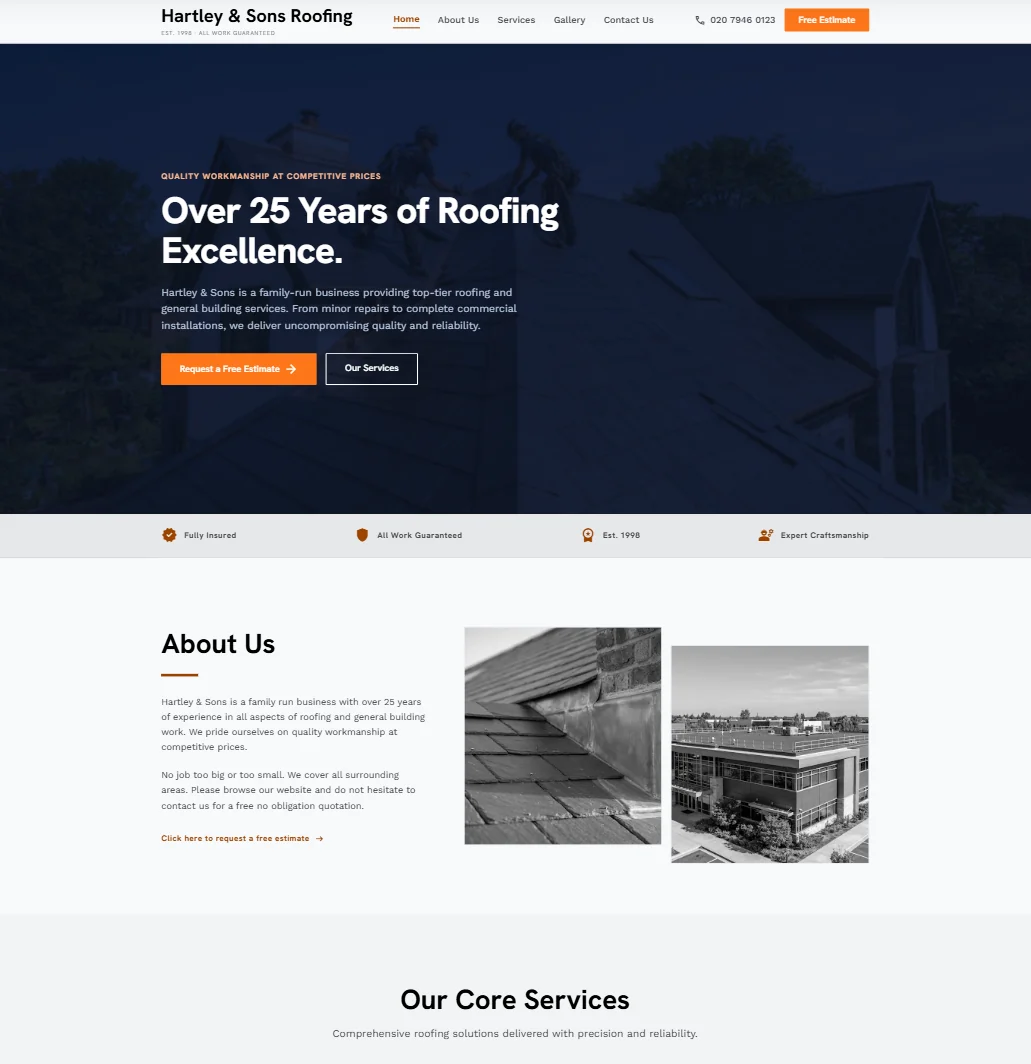
Two very different people land on a roofing site, and one built for one of them loses the other.
The emergency visitor wants a phone number, large, at the top, tappable, plus one line telling them whether you attend emergencies and roughly how quickly. They will not read your about page. They will not fill in a six field form. If the number is not obvious within a couple of seconds they are back in the search results.
The replacement visitor wants everything else, and wants it slowly. The gallery. The guarantee. What a survey involves and whether it costs anything. Whether scaffolding is included in the price. How long the job takes, what happens to the old roof, how much mess there is, whether they need to be at home.
The way to serve both is structural rather than clever. The urgent route sits in the header on every page and never moves. The body of the site is built for the person who will take three weeks to decide. Emergency work also gets its own page, because emergency roof repair is a search in its own right and the person making it deserves a page that answers them in one screen.
Most roofing searches happen on a phone, and often in circumstances nobody designs for: outdoors, in bad weather, one handed, on a patchy signal, sometimes while standing under the leak.
That has practical consequences. A site that takes five seconds to appear has lost a proportion of those people before they see anything, and they never knew what they were missing. The phone number has to be tappable. The form has to be short enough to complete while holding a bucket: name, phone, postcode, what is wrong. Photograph upload helps enormously for repairs, because a picture of the damage saves you a wasted visit.
Roof galleries are the usual culprit for slow roofing sites, because photographs of roofs are large files and most sites load all of them at once. Done properly, the images are compressed and loaded as the visitor scrolls, so the page appears immediately and the gallery fills in behind it. The site is built lean rather than assembled from page builder plugins, which is most of the reason the sites I build are quick.
The test costs you nothing. Stand in your own drive on mobile data and open your website. Time it. Then try to request a quote from your own phone without getting annoyed.
Phone photos of real jobs beat professional stock photography every time, so send what you have. Where there is a genuine gap I will tell you rather than filling it with pictures of houses that are not in this country. Then start photographing before and after on every job from now on, because in twelve months that gallery is the most valuable thing on your website and nobody else can copy it.
See a free homepage concept for your roofing firm
One price, agreed before anything starts, and it does not move unless you ask for something outside what we agreed. There is no monthly licence holding the site hostage and no lock-in. You own the design, the code and the domain, and if you ever want to move it elsewhere I will help you hand it over cleanly.
Hosting, monitoring and small updates can be handled for you on an optional care plan at £79 a month, or you can host it yourself and never hear from me again. You own the site either way.
Your services, the work you take on, your towns, your reviews and the roofing firms currently outranking you, all researched before a pixel is drawn.
Every word written for your work and your area, then reviewed by you. No filler, no stock photography of American houses, nothing describing services you do not offer.
Page structure, headings, metadata, local business schema, redirects from your old URLs so existing rankings are not thrown away, and analytics set up properly at launch rather than bolted on later.
Up to eight pages, two rounds of revisions, domain connection, form and call testing, a managed go live, and thirty days of support afterwards. Three to four weeks from start to live.
Spending £497 on the strength of a portfolio and a phone call is a leap of faith. So there is a step before it.
I will design your homepage first, in full, free. A complete bespoke desktop design and a matching mobile design, with your headline, your services, your service area, your reviews, guarantees and accreditations built in, and a clear survey request as the main action. I will also explain every design and commercial decision I made and why I made it.
Then you decide. No deposit, no obligation, nothing to cancel and no pressure afterwards. If you like it, we build the rest of the site around it. If you do not, you keep the design and we shake hands.
To be straight about what it is: it is the design of the homepage, not the built website. The working site, the other pages, the search foundations and the launch are the paid project. I already run this offer through paid search for roofing firms, so it is not something invented for this page. It is limited to established UK roofing firms, for the simple reason that designing one properly takes real hours and I can only do so many.
Good web design for a roofing business is mostly restraint. The website design decisions that matter are practical: photographs of real jobs over stock imagery, the phone number visible on every screen, the towns you cover named in words rather than implied by a map, and pages that load before a customer on a weak signal gives up. That is web design in service of the business rather than the portfolio, and it is the difference between a website that decorates and one that sells.
It is also where the marketing and the build meet. A website is the landing point for every other channel — the map listing, the reviews, the online searches, the van livery — so a design that converts poorly quietly taxes all of them. Digital marketing spend on top of a weak website is water into sand. Built properly, the same website becomes the multiplier: the business looks established, the digital shopfront matches the workmanship, and every marketing pound that sends a visitor there works harder. That is the whole argument for doing the design once, properly, in web design terms a customer never sees but always feels.
I build the site myself. Not a team you never meet, not a template with your logo dropped into it, and nothing sent offshore. You get one person who has read your reviews, looked at your competitors, and knows the difference between slate and concrete tile.
I also run Local SEO for roofing firms, which is an unusual pairing. Most web designers hand over a site and disappear. Most search providers inherit a site they would never have built and spend the first three months undoing it. Because I do both, your site launches with the structure the search work needs: a page per service, real service area pages, clean URLs, schema, and nothing that has to be unpicked in a year.
If visibility rather than presentation is your actual problem, the roofing SEO page covers that side of it. If you are not sure which it is, the free audit will tell you, including when the honest answer is that your current site is fine and you should spend the money elsewhere.
You can, and for a brand new one man business that is a reasonable first step. Two things to know. First, you are renting: stop paying and it disappears, and after five years you have spent real money and own nothing. Second, templates push you towards one Services page and a contact form, which is exactly the structure that ranks for nothing. The difference is not the pixels. It is the service pages, the speed and the fact that it is yours.
It is more than most roofing sites launch with and it covers the structure that matters: home, about, contact, and five pages for the work you actually want more of. If your plan needs thirty service area pages, that is search work rather than a website build, it is done over months, and it is priced separately. Building thirty thin pages at launch would hurt you rather than help.
Websites for roofers built around how homeowners actually choose: proof of finished work, clear services by the type of work, and an easy way to ask for a survey. Fixed at £497 and yours outright.
Often you should not. If the bones are sound and the problem is styling, a rebuild is a waste of money and I will tell you so in the audit. A rebuild earns its keep when the structure is the problem: no page for half the work you do, no gallery, painfully slow, unusable on a phone, or built on something nobody can safely edit. That is not tidying, that is a different site.
No honest person promises a position and I will not. What comes with the build is everything within my control: the page structure, on-page SEO foundations, schema, speed and the redirects that protect any ranking you already have. Getting into the map pack and onto page one from there usually needs ongoing local SEO, which is a separate service and I will tell you honestly whether you need it.
There is not one, and I understand why you are asking. I do it because it is the most convincing argument I have, and far more persuasive than a portfolio of other people's businesses. If you take the design and build it elsewhere, that is your right and the risk I accept. It is limited to established UK roofing firms because each one takes real hours.
Phone photos of real jobs beat professional stock photography every time, so send what you have. Where there is a genuine gap I will tell you rather than filling it with pictures of houses that are not in this country. Then start photographing before and after on every job from now on, because in twelve months that gallery is the most valuable thing on your website and nobody else can copy it.
You can, and for a brand new one man business that is a reasonable first step. Two things to know. First, you are renting: stop paying and it disappears, and after five years you have spent real money and own nothing. Second, templates push you towards one Services page and a contact form, which is exactly the structure that ranks for nothing. The difference is not the pixels. It is the service pages, the speed and the fact that it is yours.
It is more than most roofing sites launch with and it covers the structure that matters: home, about, contact, and five pages for the work you actually want more of. If your plan needs thirty service area pages, that is search work rather than a website build, it is done over months, and it is priced separately. Building thirty thin pages at launch would hurt you rather than help.
A new website earns its keep faster when the rest of the picture is in place. These are the next things worth reading.
Request a free website audit. I'll tell you honestly what's holding the current site back, what's worth keeping, and whether a rebuild is justified at all.
Free · reviewed personally by James · within 3 working days · no sales call